Key Takeaways
- SEO ranks pages, AEO wins the answer box, GEO gets your brand cited inside AI answers — the same content, three different retrieval contexts.
- Google's own position: optimizing for AI features is "still SEO" — no special markup, AI files or schema are required to appear in AI Overviews (Google Search Central, 2026).
- These aren't competing budgets. One well-built page can rank (SEO), be selected as a snippet (AEO) and be cited by ChatGPT (GEO) at the same time.
- Which to prioritize depends on your business type — local, e-commerce and B2B/SaaS each weight seo/geo/aeo differently.
Every week a new acronym lands in your inbox: AEO, GEO, AIO, LLMO. Vendors imply that SEO is dead and that you now need three new budgets. That's mostly noise. Underneath the labels, seo/geo/aeo are three angles on one question — when someone looks for what you sell, do you show up? — across three surfaces: the classic results page, the answer box, and the AI-generated response.
This guide demystifies the acronyms, shows you exactly where they differ, quotes what Google officially says (spoiler: it calls this "still SEO"), and gives you a simple decision framework so you know which layer to fund first based on your type of business.
1. What SEO, GEO and AEO Actually Stand For
Start with the plain definitions, because most of the confusion is just undefined jargon.
SEO — Search Engine Optimization
The original discipline: making your pages rank in search engines (Google, Bing) for the queries your customers type, so they click through to your site. It rests on keywords, quality content, crawlable technical foundations, internal links and backlinks. The success metric is rankings and organic clicks. SEO is about being a result.
AEO — Answer Engine Optimization
AEO structures your content so a machine can lift a clean, direct answer straight out of it — for a featured snippet, a voice assistant, or an AI Overview. It rewards concise, factual answer blocks, clear question-shaped headings, tables, and schema. The success metric is owning the answer, even when that answer is read without a click. AEO is about being the answer.
GEO — Generative Engine Optimization
GEO makes your brand the source a generative engine reaches for when it composes an answer. When someone asks ChatGPT, Perplexity, Gemini or Claude "what's the best X for Y?", GEO is why your name ends up in the shortlist — and your URL in the citations. It depends less on any single page and more on how consistently your brand shows up across the sources those models trust (review platforms, comparison listicles, Reddit, documentation). GEO is about being the cited source.
2. seo/geo/aeo: The Differences That Actually Matter
Here's the side-by-side that cuts through the acronym soup. Read it by column when you're deciding where a specific project belongs.
| Dimension | SEO | AEO | GEO |
|---|---|---|---|
| Goal | Rank as a result | Be the direct answer | Be the cited source |
| Where it shows | Google & Bing blue links | Featured snippets, voice, AI Overviews | ChatGPT, Perplexity, Gemini, Claude |
| Optimizes for | Keywords, links, crawlability | Answer blocks, structure, schema | Entity clarity, 3rd-party citations |
| Success metric | Rankings & organic clicks | Answer / snippet ownership | Share of voice & citations in AI |
| User gets | A link to click | An instant answer | A recommendation |
Notice the overlap: every column rewards clear structure, credible content and a well-defined brand entity. That's not a coincidence — it's the whole reason Google says the disciplines are one and the same.
Not sure where seo/geo/aeo leaves your site?
My free audit shows where you rank on Google, whether you own the answer boxes, and if ChatGPT & AI Overviews mention you. Delivered in 48h.
3. What Google Officially Says: It's "Still SEO"
This is the part the acronym vendors leave out. In its official guide to optimizing for generative AI features, Google is blunt: this is not a new discipline. In Google's words, "the best practices for SEO continue to be relevant because our generative AI features on Google Search are rooted in our core Search ranking and quality systems," and "from Google Search's perspective, optimizing for generative AI search is optimizing for the search experience, and thus still SEO."
Google is equally clear that you don't need to bolt on AI-specific plumbing: "you don't need to create new machine readable files, AI text files, markup, or Markdown to appear in Google Search (including its generative AI capabilities)." LLMs.txt files, per Google, "will neither harm nor help" your visibility in Google Search.
So why do AEO and GEO exist as terms at all? Because the surfaces are genuinely new, even if the fundamentals aren't. A large share of what AI Overviews cite also ranks in the top organic results — so classic SEO earns you the ticket to the AI game (Search Engine Journal, 2026). AEO and GEO are best understood not as replacements for SEO but as a checklist for the extra formatting and off-site signals those new surfaces reward.
Most companies I audit don't have an SEO problem and a separate AI problem. They have one content problem that shows up in three places. Fix the page properly and it starts ranking, answering and getting cited at once.
Aurélien Zeifmann — International SEO & GEO Consultant
4. Which Should You Prioritize? A Decision Framework by Business Type
You have finite time and budget, so "do all three equally" is useless advice. The right weighting for SEO vs GEO vs AEO depends on where your buyers actually search. Here's how I sequence it by business type.
| Business type | Fund first | Then add | Keep an eye on |
|---|---|---|---|
| Local / service business | SEO + Local (Maps, Business Profile) | AEO for "near me" & definitional queries | GEO — still emerging locally |
| E-commerce / D2C | SEO on category & product pages | AEO on comparison & "best" queries | GEO for product recommendations |
| B2B / SaaS | SEO for demand capture | AEO for vendor-evaluation queries | GEO — highest upside (AI shortlists) |
| Publisher / content | SEO for reach | AEO to own snippets | GEO to protect attribution |
Local & service businesses
Google Maps and your Business Profile still drive most of the pipeline, so local SEO comes first. Layer AEO on top for the definitional and "near me" questions people ask. GEO is a smart hedge — but most local buyers don't yet ask ChatGPT for a plumber, so it's a watch-list item, not your lead investment.
E-commerce & D2C
SEO on category and product pages remains the base. AEO matters more here every quarter, because AI Overviews increasingly appear on "best [product] for [use case]" and comparison queries. GEO is rising as AI assistants start recommending specific products.
B2B & SaaS
This is where GEO earns its keep. Buyers increasingly ask AI assistants to build the vendor shortlist before a human ever visits your site — and those models lean on third-party sources (G2, Capterra, Reddit, industry posts). You still need SEO to capture demand and AEO for vendor-evaluation questions, but GEO has the highest upside because it decides whether you make the AI's shortlist at all.
5. How I Get Clients Cited on Google — and Inside AI
The reason I don't treat seo/geo/aeo as three separate projects is that, done right, one strategy delivers all three. Below are real results from brands I work with: they rank on Google, they own the answer, and AI engines now recommend them by name on their highest-intent queries.
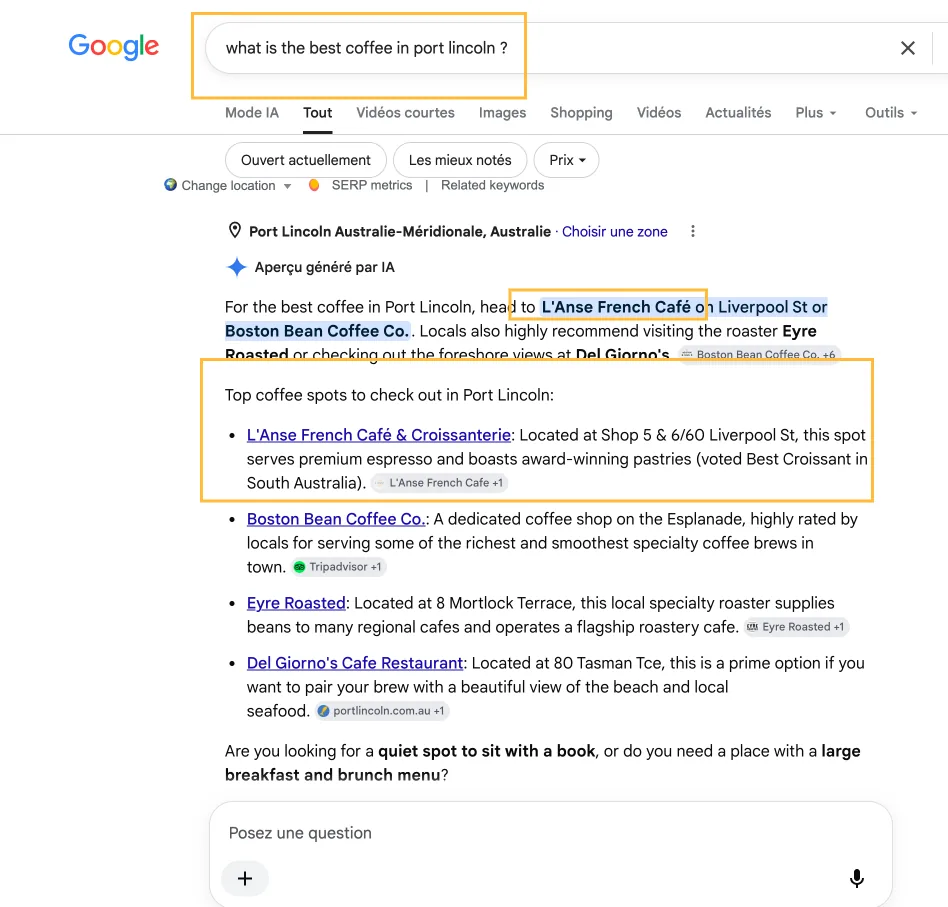
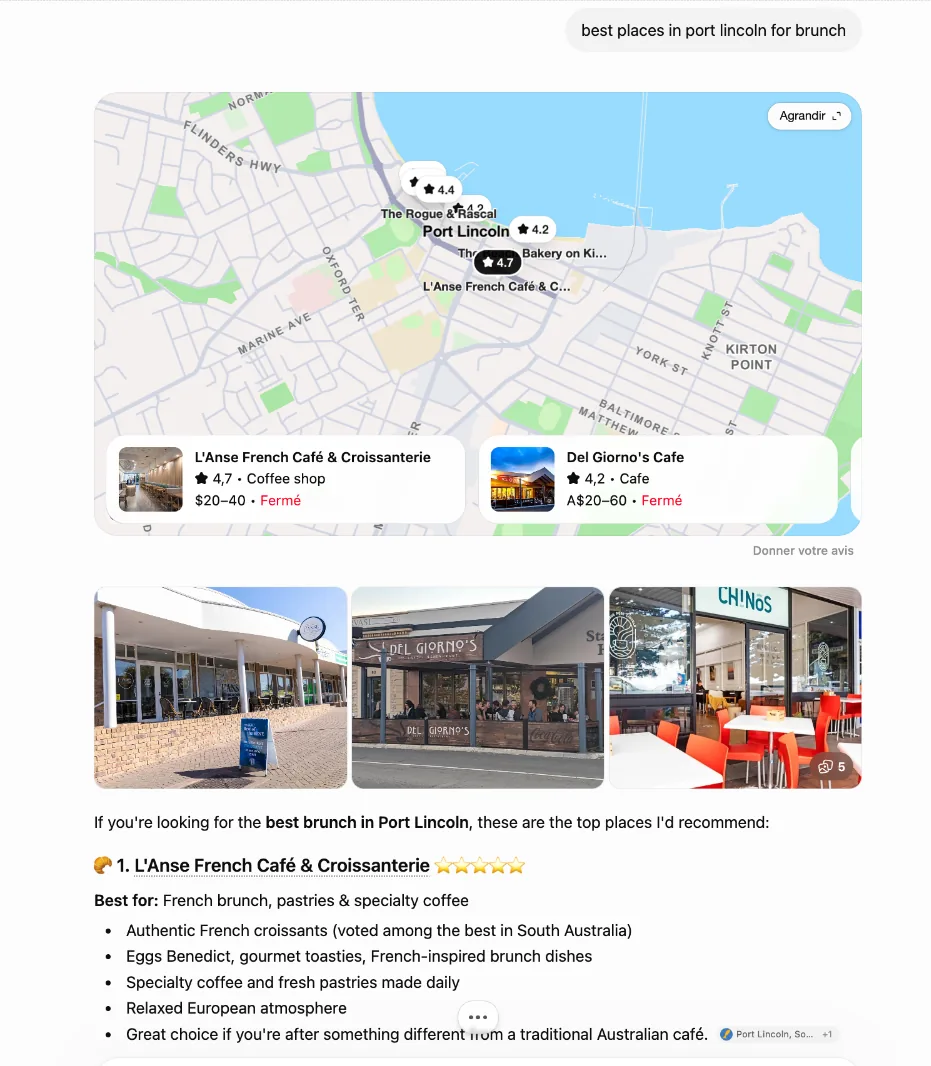
None of this came from an "AI-only" tactic. It came from strong SEO fundamentals — clear entity, credible content, clean structure, and presence on the third-party sources these engines already trust. That's the compounding advantage of building for SEO vs GEO vs AEO together instead of chasing each acronym separately. If you want to measure where you stand across all three surfaces, I break down the exact metrics in my guide on how to measure your brand's AI visibility.
6. Your seo/geo/aeo Action Plan
You don't need three teams. You need one page built to be retrieved in three contexts, then the right off-site signals. Here's the sequence I run.
- Nail the SEO fundamentals first. Crawlable, fast, well-structured pages that genuinely deserve to rank — this is the ticket to every AI surface too.
- Add answer-first formatting (AEO). Open key pages with a 2–3 sentence direct answer, use question-shaped headings, concise factual blocks, tables and FAQ schema.
- Make your brand entity unambiguous (GEO). Consistent name, description and facts across your site, schema, and the third-party sources AI cites in your category.
- Earn off-site presence where AI looks. Reviews, comparison listicles, Reddit threads and reputable industry pages — the sources that feed generative answers.
- Measure across all three surfaces. Track rankings, snippet/answer ownership, and AI mentions & citations — then re-invest where you're weakest.
Do this and the SEO vs GEO vs AEO debate dissolves: you stop choosing sides and start showing up wherever your buyer is looking — the results page, the answer box, and the AI reply.
Frequently Asked Questions
What is the difference between SEO, GEO and AEO?
SEO optimizes your pages to rank as a result on Google and Bing. AEO (Answer Engine Optimization) optimizes content to be selected as the direct answer — featured snippet, voice answer or AI Overview. GEO (Generative Engine Optimization) optimizes your brand to be the source that generative engines like ChatGPT, Perplexity, Gemini and Claude cite when they build an answer. SEO earns the click, AEO owns the answer, GEO earns the citation.
What do GEO and AEO stand for?
GEO stands for Generative Engine Optimization — getting your brand cited inside answers generated by large language models such as ChatGPT, Perplexity, Gemini and Claude. AEO stands for Answer Engine Optimization — structuring content so it is extracted and surfaced as a direct answer in featured snippets, voice assistants and AI answer boxes.
Is GEO replacing SEO?
No. GEO and AEO extend SEO rather than replace it. Google states that optimizing for its generative AI features is "still SEO," because those features are rooted in Google's core Search ranking and quality systems. Generative engines reuse the same authority, relevance and content-quality signals as classic search, so strong SEO remains the foundation that GEO and AEO build on.
Do I need AEO and GEO, or is SEO enough?
It depends on where your buyers search. If they still click blue links, SEO carries most of the value. But 65% of Google searches now end without a click, and hundreds of millions of people ask ChatGPT and AI Overviews directly — so if you're invisible in those answers, you lose demand you never see. Most businesses need all three, weighted to their business type, not one instead of the others.
Can one page be optimized for SEO, AEO and GEO at the same time?
Yes — and that's the efficient approach. A single well-built page with a clear heading structure, an answer-first paragraph, concise factual blocks, schema markup and cited statistics can rank in blue-link results (SEO), be pulled into a featured snippet or AI Overview (AEO), and be cited by ChatGPT or Perplexity (GEO). You rarely need three separate content programs; you need one page built to be retrieved in three contexts.
Which is best for my business — SEO, AEO or GEO?
Local and service businesses should prioritize SEO and local search first (Google Maps and Business Profile), add AEO for definitional queries, and treat GEO as a hedge. E-commerce should keep SEO as the base and push AEO hard on category and comparison queries where AI Overviews already appear. B2B and SaaS companies get the most from GEO, because AI assistants increasingly build the vendor shortlists buyers use — while still needing SEO and AEO underneath.
Sources & references
- Google Search Central — Optimizing your website for generative AI features on Google Search. "Still SEO," no special markup or AI files required.
- Search Engine Journal — Google's New AI Search Guide Calls AEO And GEO 'Still SEO'. Analysis of Google's guidance and organic–AI Overview overlap.
- Yext — SEO vs. AEO vs. GEO: Definitions, Key Differences, and Why They All Matter. Working definitions of the three disciplines.
- eMarketer — FAQ on GEO and AEO: Where AI search and SEO overlap in 2026. Business-type prioritization and overlap data.

Aurélien Zeifmann
Freelance international SEO & GEO consultant. I help US and international companies rank higher on Google and get recommended by ChatGPT, Gemini, Claude & Perplexity. I build one content strategy that ranks, answers and gets cited — for clients in finance, healthcare, e-commerce and local services.