Key Takeaways
- 90% of brands have zero AI search mentions, according to a 177-brand analysis across healthcare, SaaS and finance — most companies don't even know whether AI recommends them.
- AI visitors are worth more: LLM traffic converts 4.4x better than organic search (Semrush, 2025), and ChatGPT referrals convert at 15.9% vs 1.76% for Google organic (Seer Interactive, 2025).
- Four metrics matter: AI share of voice, mention rate on buying-intent prompts, citations of your pages, and AI referral traffic in GA4.
- Prompt-based monitoring tools like Otterly.AI automate tracking across ChatGPT, Google AI Overviews, AI Mode, Gemini, Perplexity and Copilot — starting at $29/month.
In 2026, the buying journey no longer starts with ten blue links. Your prospects ask ChatGPT for "the best [your category] for [their situation]" and get a shortlist of three to five brands — synthesized, opinionated, and final. If your brand isn't in that answer, you don't lose a ranking position. You simply never existed in that buyer's world.
The problem: unlike Google rankings, you can't open a SERP tracker and "see" your AI visibility. It lives inside millions of generated answers that change from prompt to prompt. This guide breaks down the measurement framework I use for my own clients — the metrics, the tool (Otterly.AI), and a 30-day process — so your company can answer one question with data: does AI recommend us, or our competitors?
1. Why AI Visibility Became a Board-Level Metric in 2026
The scale tipped fast. Google's AI Overviews now reach 2 billion monthly users across 200+ countries, ChatGPT passed 900 million weekly active users in early 2026, and roughly 65% of all searches now end without a single click to a website.
The click economy is shrinking with it. When an AI Overview appears, page-one CTR drops from 15% to 8% — a 47% decline — and the #1 organic result loses up to 58% of its clicks (AI SEO statistics, 2026). With Google's AI Mode, 93% of sessions end with zero clicks. Rankings alone no longer describe your real visibility — the answer itself is the new battleground.
Being in the answer pays
This isn't just defensive. Brands cited in AI Overviews earn 35% more organic clicks and 91% more paid clicks than brands that aren't. And Ahrefs found that AI search visitors made up just 0.5% of their traffic but drove 12.1% of all signups — a 23x higher conversion rate than classic organic (Ahrefs study, June 2025). The traffic is small; the buyers in it are not.
2. The 4 Metrics That Actually Measure AI Visibility
Forget vanity dashboards. When a company asks me "are we visible in AI?", these are the four numbers I put in front of them.
Metric #1 — AI share of voice
For a fixed set of buying-intent prompts, what percentage of AI answers mention your brand vs your competitors? This is the AI equivalent of ranking share — some tools call it "Share of Model". It's your single most important trend line, because it's benchmarkable, repeatable, and it moves when your GEO work lands.
Metric #2 — Mention rate and positioning
Being mentioned isn't binary. Are you the first recommendation or a footnote? Is the sentiment positive ("a trusted option for…") or lukewarm ("another alternative is…")? Track how AI describes you, not just whether it does — that phrasing is what millions of buyers now read as the truth about your brand.
Metric #3 — Citations of your pages
Mentions are your brand appearing in the text; citations are your URLs appearing as sources. Citations tell you which of your pages LLMs consider authoritative enough to link — and which competitor pages are feeding the answers in your category. That citation map is your content roadmap.
Metric #4 — AI referral traffic and branded lift
In GA4, segment referrals from chatgpt.com, perplexity.ai, gemini.google.com and copilot.microsoft.com. The volumes look small — until you see the quality. AI-referred sessions grew 527% year-over-year (Semrush, 2025), and per Seer Interactive (June 2025), ChatGPT referrals convert at 15.9% and Perplexity at 10.5%, versus 1.76% for Google organic. Similarweb adds that AI visitors view nearly twice as many pages and stay twice as long. Also watch branded queries in Search Console: many users see your brand in an AI answer, then Google you to verify.
Does ChatGPT recommend your brand — or your competitor?
My free SEO audit now includes an AI visibility snapshot: your mentions across ChatGPT, AI Overviews & Perplexity. Delivered in 48h.
3. How I Track It for My Clients: Otterly.AI + Prompt Monitoring
Manually asking ChatGPT "who are the best providers of X?" once a month isn't measurement — it's anecdote. For my clients, I run Otterly.AI, a monitoring platform that executes a defined library of prompts on a schedule across six AI surfaces: ChatGPT, Google AI Overviews, Google AI Mode, Gemini, Perplexity and Microsoft Copilot — then logs every brand mention, citation and sentiment shift over time.
Step 1 — Build a prompt library that mirrors real buyers
The quality of your measurement is the quality of your prompts. I build 25–50 prompts per client from three intent buckets:
- Category prompts — "best [category] for [use case/industry/city]", "top [category] tools in 2026"
- Comparison prompts — "[client] vs [competitor]", "alternatives to [market leader]"
- Reputation prompts — "is [client] legit?", "what do customers say about [client]?"
These come from sales calls, support tickets and People Also Ask data — the questions prospects actually type, not the keywords we wish they typed.
Step 2 — Baseline, then track share of voice weekly
Otterly's dashboards show mention rate per platform, share of voice against named competitors, and the exact URLs each AI engine cites. AI answers are volatile — the same prompt can produce different brands on different days — which is exactly why scheduled, repeated sampling beats one-off spot checks.
This is what it looks like for real clients. Several of the companies I work with — in finance, healthcare and local services — now appear in Google's AI Overviews and get named by ChatGPT for their highest-intent money queries:
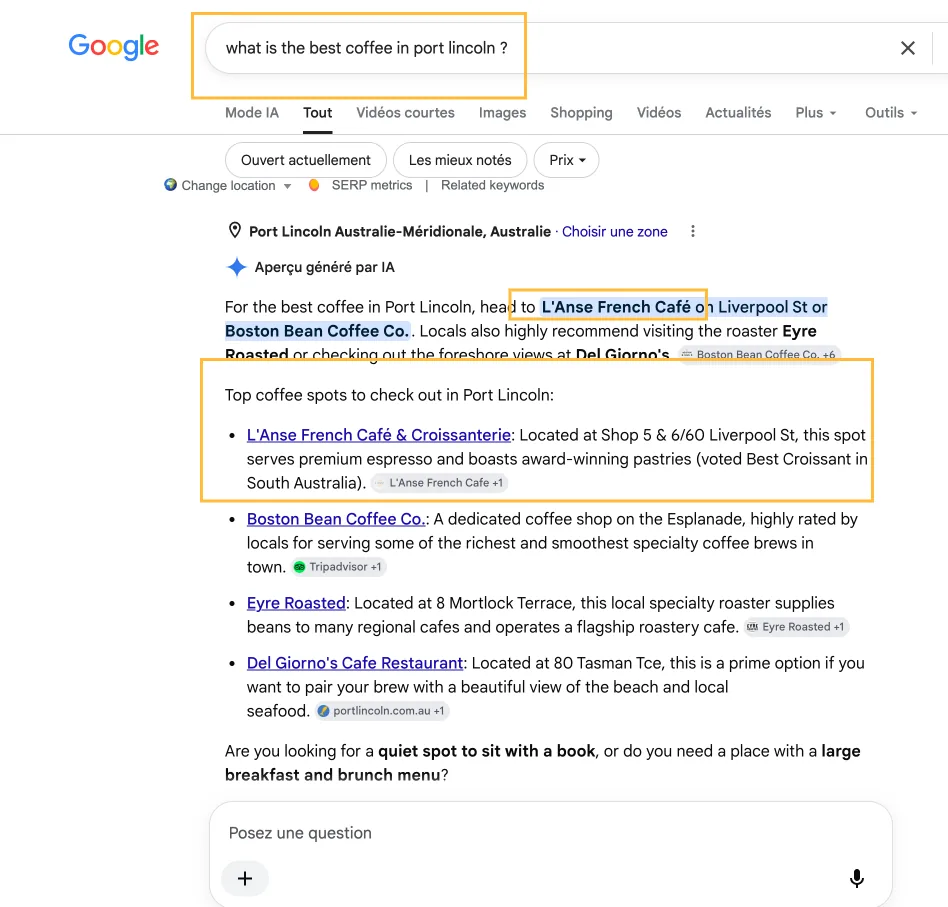
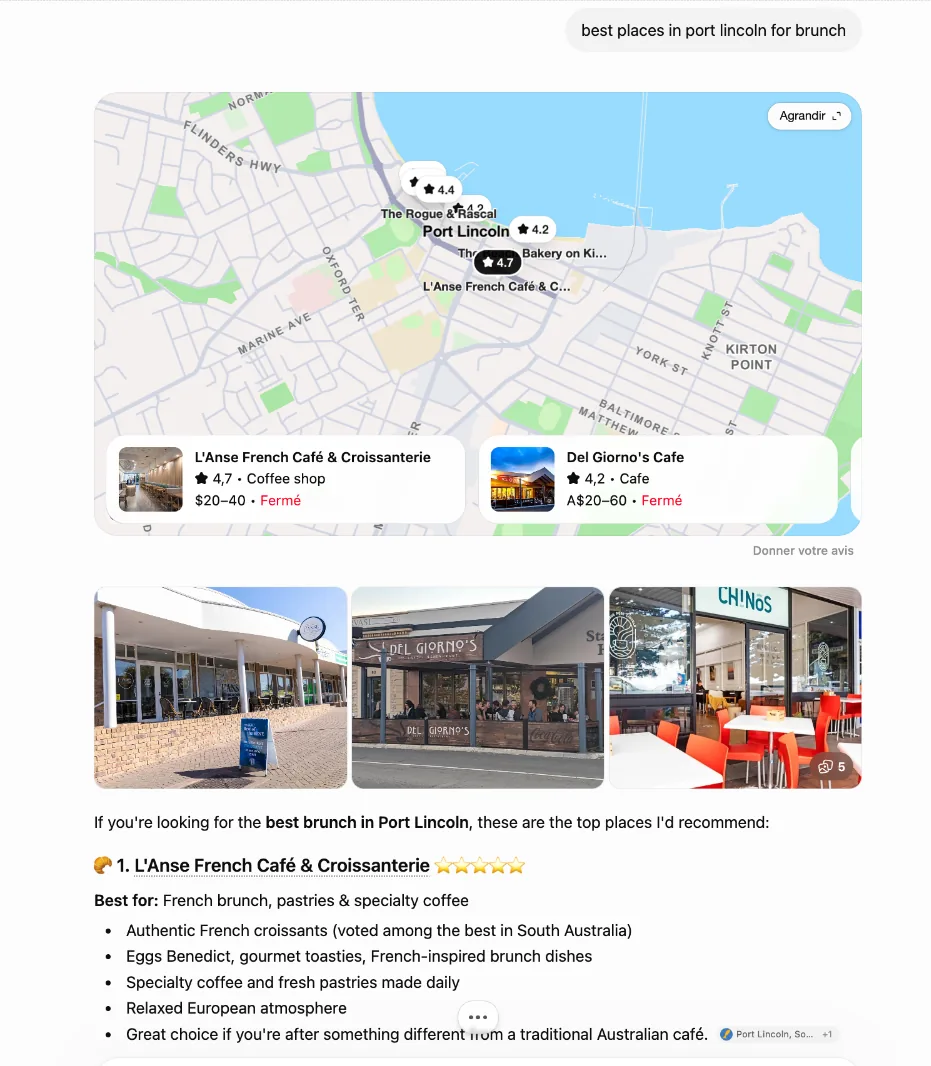
Most companies I audit have solid Google rankings and zero AI mentions. Google sees them; ChatGPT has never heard of them. You can't fix what you don't measure.
Aurélien Zeifmann — International SEO & GEO Consultant
Cost-wise, this is accessible for any serious business: Otterly.AI starts at $29/month for 15 prompts (Lite), with 100 prompts at $189/month — a fraction of what one lost enterprise deal to an "AI-recommended" competitor costs you.
4. Measurement Methods Compared: What Each Layer Catches
No single data source shows the full picture. Here's how the three practical measurement layers stack up — I recommend running all three, because they answer different questions.
| Criteria | Prompt monitoring (Otterly.AI) | GA4 AI referrals | Manual spot-checks |
|---|---|---|---|
| Sees mentions even without a click | ✓ Yes | ✗ No | ✓ Partially |
| Competitor share of voice | ✓ Yes | ✗ No | ✗ Not reliably |
| Covers AI Overviews + AI Mode + 4 LLMs | ✓ Yes | ✗ Referrers only | ✗ Too slow |
| Repeatable / trendable over time | ✓ Daily sampling | ✓ Yes | ✗ No |
| Cost | From $29/mo | Free | Free (but hours of work) |
5. Your First 30 Days: The AI Visibility Measurement Plan
Here's the exact sequence I run when a new client wants to know where they stand. You can execute it in-house in four weeks.
- Week 1 — Build the prompt library. Collect 25–50 real buyer questions from sales calls, support tickets and People Also Ask, and rewrite them as conversational prompts across the three intent buckets (category, comparison, reputation).
- Week 1 — Set the baseline. Run every prompt across ChatGPT, AI Overviews, Gemini, Perplexity and Copilot; record your share of voice against your top 3 competitors.
- Week 2 — Instrument GA4. Create a custom channel group for AI referrals (chatgpt.com, perplexity.ai, gemini.google.com, copilot.microsoft.com) and annotate the start date.
- Week 3 — Map the citations. List every URL the AI engines cite in your category — yours and your competitors'. This tells you which pages and third-party sources actually feed the answers.
- Week 4 — Report and prioritize. Present the four metrics, then flag the 10 highest-intent prompts where your brand has zero mentions. That shortlist is your GEO roadmap for the next quarter.
6. Invisible in AI? What the Data Says to Do Next
If your baseline comes back near zero, you're in the statistical majority — remember, 90% of analyzed brands had no AI search mentions at all. That's bad news for them and an opening for you: AI answers concentrate on a handful of brands per category, and those slots are still being assigned.
The playbook that moves the metrics is what the industry now calls GEO (Generative Engine Optimization): publish answer-first pages with sourced statistics and clean heading structure, add schema markup, earn presence on the third-party sources LLMs already cite in your category (review platforms, comparison listicles, Reddit threads), keep content demonstrably fresh, and make your brand entity unambiguous across the web. Measure for 30 days, optimize for 90, re-measure — the brands doing this now are the ones AI will keep recommending when your buyers ask.
Frequently Asked Questions
What is AI brand visibility?
AI brand visibility is how often — and how favorably — AI assistants like ChatGPT, Google AI Overviews, Gemini, Perplexity and Copilot mention or cite your brand when users ask questions in your category. It's measured with metrics like AI share of voice, mention rate, citations and sentiment, rather than traditional rankings.
How do I check if ChatGPT recommends my brand?
The quick check: ask ChatGPT 10–15 buying-intent questions in your category ("best [category] for [use case]") in a fresh session and note whether you appear. For reliable data, use a monitoring tool like Otterly.AI that runs a fixed prompt library on a schedule — AI answers vary day to day, so one-off checks can mislead you.
Is ranking #1 on Google enough to appear in AI answers?
No. AI engines synthesize answers from many sources — review sites, comparison articles, Reddit, documentation — not just top-ranked pages. That's why 90% of brands in a 177-brand analysis had zero AI mentions despite many having solid organic rankings. Rankings and AI visibility are correlated but separate battles.
How much does AI visibility monitoring cost?
Entry-level prompt monitoring starts at $29/month (Otterly.AI Lite, 15 prompts); 100 prompts run $189/month. Enterprise platforms cost significantly more. GA4 referral tracking and Search Console branded-query monitoring are free complements. My free SEO audit includes a first AI visibility snapshot of your brand.
How often should we measure AI visibility?
Sample daily or weekly (automated), report monthly. AI answers are far more volatile than search rankings — the same prompt can return different brands on different days — so trends over 30+ days matter more than any single reading.
Sources & references
- Position Digital — AI SEO Statistics 2026. AI Overview reach (2B monthly users, 200+ countries) and zero-click search share.
- SLT Creative — AI SEO Statistics 2026. AI Overview click-through decline and Google AI Mode zero-click rate.
- Omnibound — AI Search Statistics. Ahrefs study (June 2025): AI-referred traffic share, signup contribution and conversion rate.
- Semrush — AI SEO Statistics. 527% year-over-year growth in AI-referred sessions.
- Otterly.AI — AI search monitoring platform and pricing. Prompt-level tracking across ChatGPT, AI Overviews, Gemini, Perplexity and Copilot.

Aurélien Zeifmann
Freelance international SEO & GEO consultant. I help US and international companies rank higher on Google and get recommended by ChatGPT, Gemini, Claude & Perplexity. I run prompt-level AI visibility tracking (Otterly.AI) for clients in finance, healthcare, e-commerce and local services.